
SECURE OPEN SOLUTIONS
RMF / ATO
Organize the security work, documentation and evidence needed to support a government authorization decision.
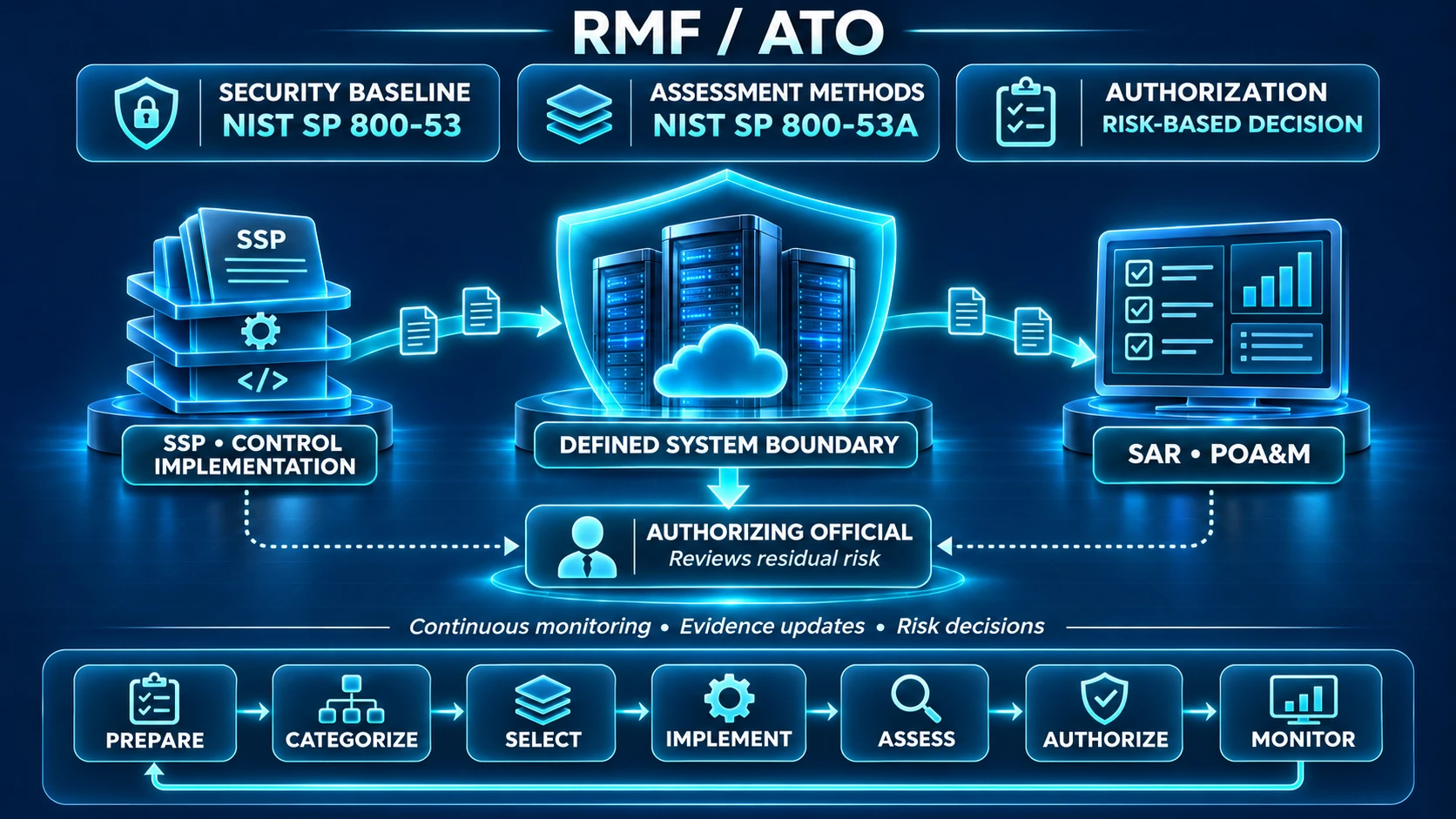
Explore the details
Prepare
Preparation establishes why the system exists, who is accountable and how security and privacy decisions will be made. It aligns the mission, acquisition context, stakeholders, dependencies and authorization expectations before teams invest in a package.
What this includes
- Identify system owners, stakeholders, interfaces and decision authorities
- Confirm mission priorities, constraints and the intended authorization milestone
- Agree responsibilities, information needs and the plan for completing the RMF work
The team begins with an agreed direction, named owners and a realistic work plan. Early questions about scope, common services and review expectations are resolved before they become costly documentation changes.
Explore details →Categorize
Categorization examines the information the system handles and the consequences of losing confidentiality, integrity or availability. The analysis must reflect the mission and business impact, rather than simply copying a category from a similar system.
What this includes
- Inventory information types and describe their use within the boundary
- Evaluate potential consequences of loss with mission and information owners
- Record the rationale, dependencies and required owner reviews
A documented impact rationale supports subsequent control selection and scope decisions. It should explain the information and mission assumptions so that changes can be recognized and reassessed. The review should retain information-type inventory so the team can explain the decisions later.
Explore details →Select
Control selection turns risk and impact decisions into an implementable set of security and privacy responsibilities. Baseline controls must be tailored to the system context, with inherited services and local implementation obligations clearly identified.
What this includes
- Confirm the applicable baseline and organization-specific direction
- Document tailoring decisions, common controls and shared responsibilities
- Define an assessment and monitoring approach for the selected controls
The selected control set has a rationale and an owner for implementation. Teams can distinguish inherited protection from safeguards that must be implemented and evidenced within the system. The review should retain control applicability and tailoring register so the team can explain the decisions later.
Explore details →Implement
Implementation puts the selected safeguards into the system and explains how they operate. Documentation should describe the actual environment, including responsible roles, mechanisms, parameters and dependencies, instead of repeating requirement language.
What this includes
- Coordinate technical and procedural safeguards with accountable owners
- Document actual configurations, workflows and shared-control implementation
- Connect each implementation statement to reviewable evidence
The system security and privacy documentation explains what is implemented and how it can be demonstrated. Gaps are visible, assigned and tracked rather than hidden behind future-tense narratives. The review should retain implementation narratives and evidence mapping so the team can explain the decisions later.
Explore details →Assess
Assessment evaluates whether safeguards are implemented as intended and support the required outcomes. A useful assessment combines an agreed plan with evidence examination, interviews and testing, then records findings in a form the system owner can act on.
What this includes
- Agree assessment scope, procedures, access and evidence arrangements
- Examine records, interview responsible personnel and test relevant behavior
- Document results, limitations and remediation responsibilities
Assessment results distinguish demonstrated implementation from unsupported claims and planned improvements. Findings become traceable inputs to risk decisions and corrective action. The review should retain assessment planning and evidence requests so the team can explain the decisions later.
Explore details →Monitor
Monitoring keeps the authorization picture current as systems, threats and responsibilities change. It connects recurring reviews and technical findings to the system boundary, implementation documentation and corrective actions, rather than treating authorization as a one-time document exercise.
What this includes
- Define review activities, reporting cadence and accountable owners
- Evaluate changes, findings and evidence for their security impact
- Maintain remediation status and communicate significant changes to the responsible authority
Owners receive current, reviewable information about system risk. Changes can trigger focused reassessment, document updates or escalation instead of accumulating unnoticed between major reviews. The review should retain monitoring schedule and evidence register so the team can explain the decisions later.
Explore details →Security Baseline
A security baseline provides a starting control set that must be related to the system, information and responsible organization. The practical work is understanding applicability, parameters, shared services and the evidence needed to explain the selected safeguards.
What this includes
- Confirm the baseline expected by the system owner
- Record tailoring, parameters and inherited-control coverage
- Map controls to implementation owners and evidence sources
An agreed baseline reduces conflicting assumptions between engineering, documentation and assessment teams. It provides a stable reference for tracking implementation and changes. The review should retain baseline and applicability register so the team can explain the decisions later.
Explore details →Assessment Methods
Assessment methods explain how a claim about a safeguard will be evaluated. They help the team choose records to examine, people to interview and system behavior to test, with enough depth and coverage for the agreed assessment scope.
What this includes
- Map objectives to examination, interview and test activities
- Select representative systems, records and responsible personnel
- Record assumptions, limitations and how results will be documented
A reviewable assessment approach makes requests more focused and findings easier to understand. It also separates missing evidence from observed implementation problems. The review should retain objective-to-method matrix so the team can explain the decisions later.
Explore details →Risk-Based Decision
A risk-based decision weighs what the evidence shows, which weaknesses remain and what operating conditions may be necessary. Decision support should make uncertainty visible and identify who owns mitigation, acceptance and ongoing review.
What this includes
- Relate findings to mission impact and realistic exposure
- Compare remediation and operational options with accountable owners
- Record decision inputs, conditions and follow-up responsibilities
Leadership can follow the reasoning from system evidence to proposed action. Decisions remain tied to a defined scope and can be revisited when assumptions change. The review should retain risk decision briefing so the team can explain the decisions later.
Explore details →Scope and Deliverables
A useful RMF / ATO support engagement begins with a defined boundary, an agreed outcome and a clear division of responsibilities. Scope makes the work understandable before estimates and schedules are finalized, and deliverables describe what the customer will be able to review or use.
What this includes
- Confirm the systems, business needs, applicable requirements and delivery constraints
- Agree roles, inputs, exclusions, acceptance criteria and review milestones
- Identify the records, procedures and implementation work needed to support the outcome
The result is a practical statement of work with reviewable outputs and accountable owners. Assumptions and dependencies remain visible so changes can be assessed before they affect cost or schedule.
Explore details →